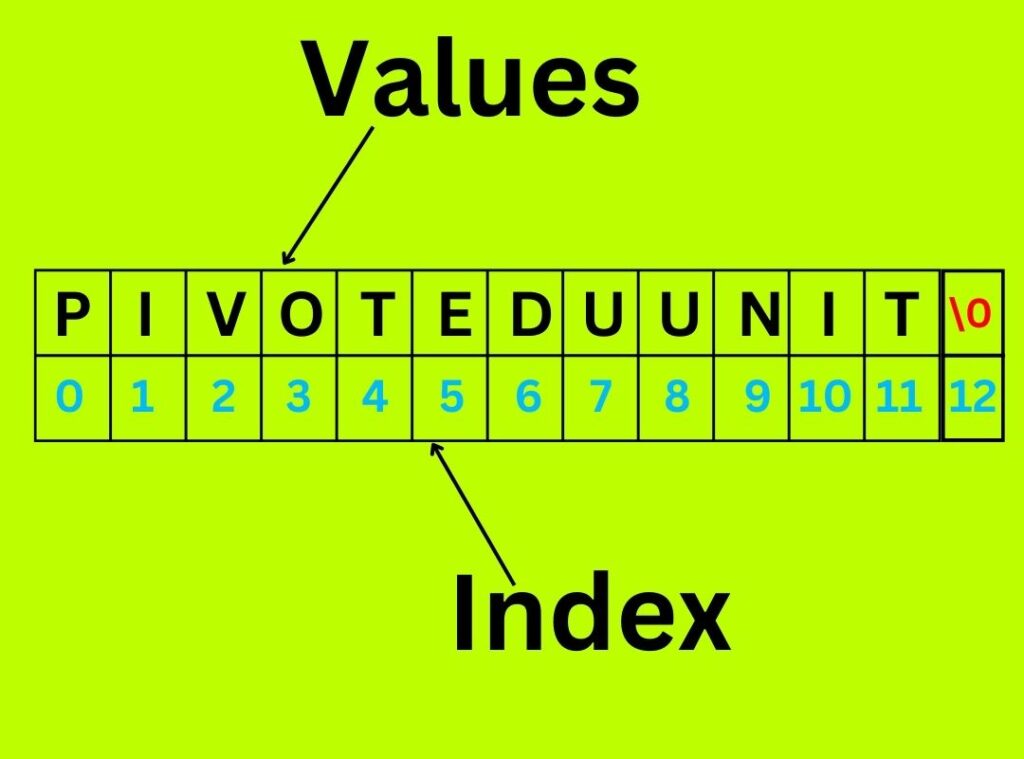
In C programming, a string is essentially an array of characters ending with a null character ('\0'). This null character signifies the end of the string. Strings are used to store and manipulate text, making them a crucial aspect of many programs.
char str[12]={“PIVOTEDUUNIT”}
Here are some question on Strings for better understanding
Write a program in C to input a string and print it.
#include <stdio.h>

int main() {
    char str[100];

    printf("Enter a string: ");
    fgets(str, 100, stdin); // Read a string including spaces

    printf("You entered: %s\n", str);

    return 0;
}
WAP in C to Read & write Strings in C using Printf() and Scanf() functions
#include <stdio.h>
#include <string.h>
int main()
{
    /* String Declaration*/
    char nickname[20];

    printf("Enter your Nick name:");

    /* Reading String Using Scanf */
    scanf("%s", nickname);  // Note there is No "&" while Reading String

    /*Printing String*/
    printf("%s",nickname);

    return 0;
}
Read & Write Strings in C using gets() and puts() functions.
#include <stdio.h>
#include <string.h>
int main()
{
    /* String Declaration*/
    char nickname[20];

    /* Getting Message to Show Message using puts */
    puts("Enter your Nick name:");

    /*Input using gets*/
    gets(nickname);

    puts(nickname);

    return 0;
}
Write a program in C to find the length of a string without using built-in functions.
#include <stdio.h>

int main() {
    char str[100];
    int i, count = 0;

    printf("Enter a string: ");
    fgets(str, 100, stdin); // Read the string (optional, can be replaced with getchar() loop)

    // Iterate through the string until the null terminator is found
    for (i = 0; str[i] != '\0'; i++) {
        count++;
    }

    printf("The length of the string is %d\n", count);

    return 0;
}
Write a program in C to separate individual characters from a string without using built-in functions
#include <stdio.h>

int main() {
    char str[100];
    int i;

    printf("Enter a string: ");
    fgets(str, 100, stdin); // Read the string

    printf("Individual characters:\n");

    // Iterate through the string until the null terminator is found
    for (i = 0; str[i] != '\0'; i++) {
        printf("%c ", str[i]); // Print each character with a space
    }

    printf("\n"); // Add a newline at the end

    return 0;
}
WAP in C program to print individual characters of a string in reverse order without using built-in functions.
#include <stdio.h>

int main() {
    char str[100];
    int i, length;

    printf("Enter a string: ");
    fgets(str, 100, stdin); // Read the string

    // Find the length of the string (excluding null terminator)
    length = 0;
    while (str[length] != '\0') {
        length++;
    }

    printf("Characters in reverse order:\n");

    // Iterate from the end of the string to the first character
    for (i = length - 1; i >= 0; i--) {
        printf("%c ", str[i]); // Print each character with a space
    }

    printf("\n"); // Add a newline at the end

    return 0;
}
WAP in C program to count the total number of words in a string without using built-in functions
#include <stdio.h>

int main() {
    char str[100];
    int i, word_count = 0;

    printf("Enter a string: ");
    fgets(str, 100, stdin); // Read the string

    // Consider the first character as a potential word start
    if (str[0] != ' ' && str[0] != '\0') {
        word_count++;
    }

    // Iterate through the string
    for (i = 1; str[i] != '\0'; i++) {
        // Check for transition from non-space to space (word boundary)
        if (str[i] == ' ' && str[i - 1] != ' ') {
            word_count++;
        }
    }

    printf("The number of words in the string is: %d\n", word_count);

    return 0;
}
WAP in C program to concat two strings using built-in functions.
#include <stdio.h>
#include <string.h>
int main()
{
     char s1[10] = "Hello";
     char s2[10] = "World";
     strcat(s1,s2);
     printf("Output string after concatenation: %s", s1);
     return 0;
}
WAP in C program to reverse a string using built-in functions.
#include<stdio.h>
#include <string.h>
int main(){
  char str[20];
  printf("Enter string: ");
  gets(str);//takes input string from user
  printf("String is: %s",str);
  printf("\nReverse String is: %s",strrev(str));
 return 0;
}
WAP in C program to convert string from upper to lower case using built-in functions.
#include<stdio.h>
#include <string.h>
int main(){
  char str[20];
  printf("Enter string: ");
  gets(str);//Takes Input string from user
  printf("String is: %s",str);
  printf("\nLower String is: %s",strlwr(str));
 return 0;
}
WAP in C program to convert string from upper to lower case using built-in functions.
#include<stdio.h>
#include <string.h>
int main(){
  char str[20];
  printf("Enter string: ");
  gets(str);//Takes Input string from user
  printf("String is: %s",str);
  printf("\nLower String is: %s",strlwr(str));
 return 0;
}
WAP in C program to convert string from upper to lower case without using built-in functions.
#include <stdio.h>

int main() {
    char str[100];
    int i;

    printf("Enter a string in uppercase: ");
    fgets(str, sizeof(str), stdin);

    // Remove trailing newline from fgets
    str[strcspn(str, "\n")] = '\0';

    // Convert to lowercase
    for (i = 0; str[i] != '\0'; i++) {
        if (str[i] >= 'A' && str[i] <= 'Z') {
            str[i] = str[i] + 32; // Add 32 to convert uppercase to lowercase
        }
    }

    printf("String in lowercase: %s\n", str);

    return 0;
}
WAP in C program to convert string from lower to upper case without using built-in functions.
#include <stdio.h>

int main() {
    char str[100];
    int i;

    printf("Enter a string in lowercase: ");
    fgets(str, sizeof(str), stdin);

    // Remove trailing newline from fgets
    str[strcspn(str, "\n")] = '\0';

    // Convert to uppercase
    for (i = 0; str[i] != '\0'; i++) {
        if (str[i] >= 'a' && str[i] <= 'z') {
            str[i] = str[i] - 32; // Subtract 32 to convert lowercase to uppercase
        }
    }

    printf("String in uppercase: %s\n", str);

    return 0;
}
Write a program in C to count the total number of alphabets, digits and special characters in a string without built-in functions
#include <stdio.h>

int main() {
    char str[100];
    int i, alphabets = 0, digits = 0, special_chars = 0;

    printf("Enter a string: ");
    fgets(str, 100, stdin); // Read the string

    // Iterate through the string
    for (i = 0; str[i] != '\0'; i++) {
        char ch = str[i];

        // Check for alphabets (lowercase and uppercase)
        if ((ch >= 'a' && ch <= 'z') || (ch >= 'A' && ch <= 'Z')) {
            alphabets++;
        } else if (ch >= '0' && ch <= '9') {
            digits++;
        } else {
            special_chars++;
        }
    }

    printf("Number of alphabets: %d\n", alphabets);
    printf("Number of digits: %d\n", digits);
    printf("Number of special characters: %d\n", special_chars);

    return 0;
}
Write a program in C to compare two strings without using string library functions without using built-in functions.
#include <stdio.h>

int main() {
    char str1[100], str2[100];
    int i, mismatch = 0;

    printf("Enter the first string: ");
    fgets(str1, 100, stdin); // Read the first string

    printf("Enter the second string: ");
    fgets(str2, 100, stdin); // Read the second string

    // Compare characters one by one, incrementing a mismatch flag if differences are found
    for (i = 0; str1[i] != '\0' || str2[i] != '\0'; i++) {
        if (str1[i] != str2[i]) {
            mismatch = 1;
            break; // Exit the loop on the first mismatch
        }
    }

    if (mismatch == 0) {
        printf("Strings are equal.\n");
    } else {
        printf("Strings are not equal.\n");
    }

    return 0;
}
Write a program in C to copy one string to another string without built-in functions
#include <stdio.h>

int main() {
    char str1[100], str2[100];
    int i;

    printf("Enter a string: ");
    fgets(str1, 100, stdin); // Read the string (optional, can be replaced with a loop using getchar())

    // Iterate through the string and copy characters one by one
    i = 0;
    while (str1[i] != '\0') {
        str2[i] = str1[i];
        i++;
    }

    // Add the null terminator manually to the copied string
    str2[i] = '\0';

    printf("Copied string: %s\n", str2);

    return 0;
}
Write a program in C to find the maximum number of characters in a string without using built-in functions.
#include <stdio.h>

int main() {
    char str[100];
    int i, length = 0;

    printf("Enter a string: ");
    fgets(str, 100, stdin); // Read the string (optional, can be replaced with a loop using getchar())

    // Iterate through the string until the null terminator is found
    for (i = 0; str[i] != '\0'; i++) {
        length++;
    }

    printf("The maximum number of characters in the string is: %d\n", length);

    return 0;
}
Write a C program to sort a string array in ascending order without using built-in functions.
#include <stdio.h>

int main() {
    char str[100];
    int i, length = 0;

    printf("Enter a string: ");
    fgets(str, 100, stdin); // Read the string (optional, can be replaced with a loop using getchar())

    // Iterate through the string until the null terminator is found
    for (i = 0; str[i] != '\0'; i++) {
        length++;
    }

    printf("The maximum number of characters in the string is: %d\n", length);

    return 0;
}
Write a C program to check whether a substring is present in a string without using built-in functions.
#include <stdio.h>

int main() {
    char str[100], sub_str[50];
    int i, j, found = 0;

    printf("Enter the main string: ");
    fgets(str, 100, stdin); // Read the main string

    printf("Enter the substring to search: ");
    fgets(sub_str, 50, stdin); // Read the substring

    // Remove the newline character (optional)
    str[strcspn(str, "\n")] = '\0'; // Using strcspn for newline check (optional)
    sub_str[strcspn(sub_str, "\n")] = '\0'; // Optional, can be commented out

    // Iterate through the main string
    for (i = 0; str[i] != '\0'; i++) {
        // Check if the current character matches the first character of the substring
        if (str[i] == sub_str[0]) {
            // Inner loop to compare substring characters
            for (j = 0; sub_str[j] != '\0' && str[i + j] != '\0' && sub_str[j] == str[i + j]; j++) {
                // Continue as long as characters match
            }

            // Check if the inner loop completed without mismatch (substring found)
            if (sub_str[j] == '\0') {
                found = 1;
                break; // Exit the outer loop if substring found
            }
        }
    }

    if (found == 1) {
        printf("Substring is present in the main string.\n");
    } else {
        printf("Substring is not present in the main string.\n");
    }

    return 0;
}
Write a program in C to find the length of a string using built-in functions.
#include <stdio.h>
#include <string.h> // For strlen

int main() {
    char str[100];
    int length;

    printf("Enter a string: ");
    fgets(str, 100, stdin); // Read the string (including newline)

    length = strlen(str); // Use strlen to get the length (excluding null terminator)

    printf("The length of the string is: %d\n", length - 1); // Adjust for newline

    return 0;
}
Here’s a C program to check whether a substring is present in a string using built-in functions.
#include <stdio.h>
#include <string.h> // For strstr

int main() {
    char str[100], sub_str[50];
    char *result;

    printf("Enter the main string: ");
    fgets(str, 100, stdin); // Read the main string (including newline)

    printf("Enter the substring to search: ");
    fgets(sub_str, 50, stdin); // Read the substring (including newline)

    // Remove trailing newline (optional)
    str[strcspn(str, "\n")] = '\0';
    sub_str[strcspn(sub_str, "\n")] = '\0';

    result = strstr(str, sub_str); // Search for substring in main string

    if (result != NULL) {
        printf("Substring is present in the main string.\n");
    } else {
        printf("Substring is not present in the main string.\n");
    }

    return 0;
}
Write a C program to sort a string array in ascending order using built-in functions.
#include <stdio.h>
#include <string.h> // For strcmp and qsort

int compareStrings(const void *a, const void *b) {
    const char *strA = (const char *)a;
    const char *strB = (const char *)b;
    return strcmp(strA, strB);
}

int main() {
    char str_array[100][50]; // Array to store strings (adjust size as needed)
    int num_strings, i;

    printf("Enter the number of strings: ");
    scanf("%d", &num_strings); // Read the number of strings

    printf("Enter %d strings:\n", num_strings);
    for (i = 0; i < num_strings; i++) {
        scanf("%s", str_array[i]); // Read each string
    }

    printf("\nStrings before sorting:\n");
    for (i = 0; i < num_strings; i++) {
        printf("%s\n", str_array[i]);
    }

    qsort(str_array, num_strings, sizeof(str_array[0]), compareStrings); // Sort the array

    printf("\nStrings after sorting:\n");
    for (i = 0; i < num_strings; i++) {
        printf("%s\n", str_array[i]);
    }

    return 0;
}
Write a program in C to copy one string to another string using built-in functions
#include <stdio.h>
#include <string.h> // For strcpy

int main() {
    char source[100], destination[100];

    printf("Enter a string to copy: ");
    fgets(source, 100, stdin); // Read the source string (including newline)

    // Remove trailing newline (optional)
    source[strcspn(source, "\n")] = '\0';

    strcpy(destination, source); // Copy using strcpy

    printf("The copied string is: %s\n", destination);

    return 0;
}
Write a program in C to compare two strings without using string library functions using built-in functions.
#include <stdio.h>
#include <string.h>

int main() {
    char str1[100], str2[100];

    printf("Enter the first string: ");
    scanf("%s", str1);

    printf("Enter the second string: ");
    scanf("%s", str2);

    int result = strcmp(str1, str2);

    if (result == 0)
        printf("Both strings are equal.\n");
    else if (result < 0)
        printf("First string is lexicographically less than second string.\n");
    else
        printf("First string is lexicographically greater than second string.\n");

    return 0;
}
Write a program in C to find the length of a string using built-in functions.
#include <stdio.h>
#include <string.h>

int main() {
  char str[100];
  int length;

  printf("Enter a string: ");
  fgets(str, sizeof(str), stdin);

  // Remove trailing newline from fgets
  str[strcspn(str, "\n")] = '\0';

  // Use strlen to get the length (excluding null terminator)
  length = strlen(str);

  printf("The length of the string is: %d\n", length);

  return 0;
}